A YouTube automation agency is a company that researches, scripts, voices, edits and uploads videos for a channel someone else owns, usually a faceless one, for a monthly fee. Published prices are rare: ZAN says its monthly engagements start at $499, YT Wealth Media shows no price at all, and channel management at Tasty Edits costs $1,490 to $2,370 a month before any editing. An agency can save you time, but it can't guarantee income, and the channel's policy risk stays with you.
This guide covers what these agencies do and what they charge, using only the numbers they publish. Then come the contract terms to check, the red flags, the FTC's rules on earnings claims, and how running the work in-house with AI compares. VidGenn, which publishes this guide, makes AI documentary videos, so we've kept agency facts to what agencies say about themselves. For the bigger picture, see our guide to YouTube automation with AI.
How we checked: we read each agency's own website and terms, Tasty Edits' and Vidpros' pricing pages, the FTC's Business Opportunity Rule guidance and YouTube Help on 18 November 2026. We did not hire any agency. Where a company hides a number, we say so instead of guessing.
Key takeaways: (1) Of the two automation agencies we checked, only ZAN publishes a starting price ($499 a month); YT Wealth Media asks you to contact it. (2) Management-only plans cost $1,490 to $2,370 a month at Tasty Edits, and editing is extra. (3) Any income promise is a red flag: the FTC requires sellers of business opportunities to back earnings claims in writing and wait 7 days before you sign. (4) Eight 10-minute videos a month cost about $639 in-house with VidGenn Pro plus an editor (our estimate).
What does a YouTube automation agency do?
"YouTube automation" is a loose name. It rarely means software runs your channel. It usually means a team does the production steps so the owner doesn't appear on camera or touch the editing. Most agencies sell some mix of these services:
- Niche and topic research: picking a niche and titles with search and competitor data.
- Scripts: writers turn approved titles into narration scripts.
- Voiceover: human voice artists or AI voices read the script.
- Editing: footage, graphics, music and captions cut to the narration.
- Thumbnails: usually two or three options per video.
- Uploading and channel management: titles, descriptions, scheduling, comments and analytics.
The business model comes in three shapes. Done-for-you production sells a fixed number of videos a month. Channel management runs publishing and strategy but leaves editing to you or a separate package. A few offers add a revenue share, where the agency takes a cut of channel income on top of, or instead of, a fee. None of the three agencies we read publishes a revenue share. If one is offered to you, get the percentage, the revenue it applies to, and the end date in writing. If you're comparing done-for-you offers specifically, our done-for-you YouTube channel guide goes deeper.
What ZAN, YT Wealth Media and others say they offer
Here is what each company states on its own site. We list facts, not verdicts, and we did not test their service.
| Company | What it says it does | Published price | Guarantee or terms shown |
|---|---|---|---|
| ZAN | Channel management, research and scripting, editing, thumbnails, faceless and talking-head production, in English, Spanish, German, Urdu and Hindi | Monthly engagements from $499; consultations $50 an hour | "Committed professional work under a written scope"; no new project slots this quarter (waitlist) |
| YT Wealth Media | Research, scripts, human voiceover, editing, 2–3 thumbnails per video, publishing and management | Not shown: "Contact us" for pricing. Plans of 8, 12 or 16 videos a month | Footer: 30-day money-back guarantee, no setup fees, cancel anytime. Terms: fees for work done are "generally non-refundable" |
| Tasty Edits (management) | Dedicated channel manager, uploads, community posts, comment replies, audit, strategy calls | Starter $1,490/month, Pro $2,370/month (quarterly); $1,266 and $2,014 billed yearly | Editing is a separate purchase; 14-day trial listed |
Two details are worth reading twice. YT Wealth Media's FAQ says "You retain full ownership and control" of your channel, and its terms say deliverables become yours only on full payment. Its terms also say it does "not guarantee specific results, revenue, subscriber counts, monetization timelines, or channel approval outcomes". That's an honest line, and it's the line that governs, whatever a sales call says. ZAN shows aggregate results (40M+ views, $200K+ generated) backed by anonymized screen recordings, which you can ask to see in a call.
How much does a YouTube automation agency cost?
Most agencies price on a call, so the honest answer is "often not shown on the pricing page". The figures that are public range from a $499 starting point to several thousand a month once editing and management are combined.
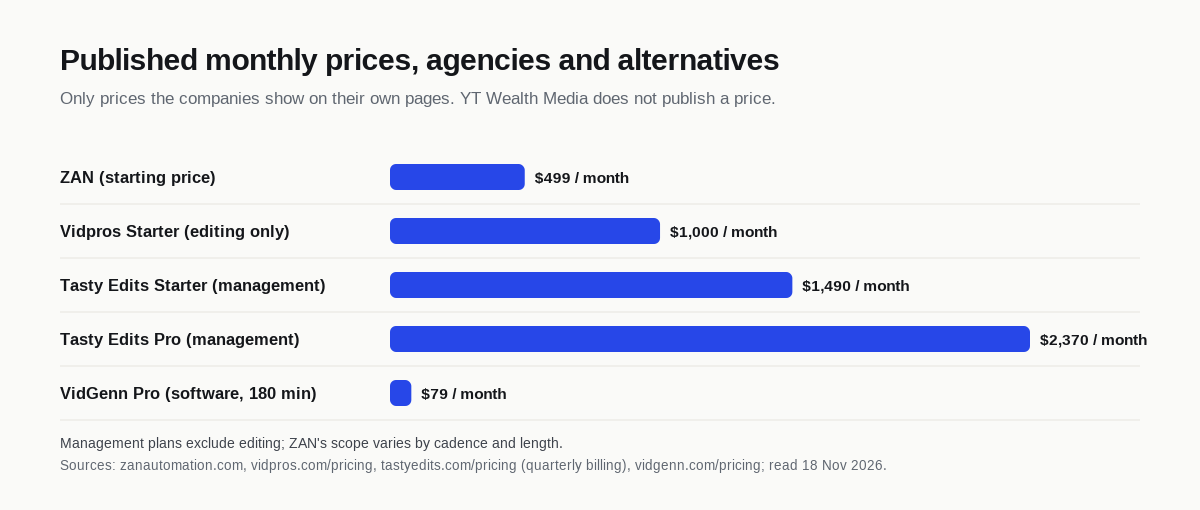
Editing on its own has clearer prices. Tasty Edits charges $327 for one horizontal video, falling to $278 each in an 8-video pack, with 48-hour turnaround (Tasty Edits pricing). Vidpros sells month-to-month editing at $1,000 for 5 to 10 long-form videos (Vidpros pricing). Our guide to YouTube video editing services compares those options. For the full cost of a video, line by line, see how much YouTube automation costs.
Which contract terms should you check?
The contract matters more than the sales page. Ask for these points in writing before you pay anything:
- Scope: videos per month, length, and what counts as a revision. A plan of "12 videos" means little without a length.
- Ownership: the channel, the AdSense account, scripts, project files and voice recordings all belong to you. Ask when ownership transfers (YT Wealth Media's terms say on full payment).
- Access: the agency gets a role through YouTube Studio channel permissions, never your Google password (YouTube Help).
- Revenue share: if any, the percentage, what income it covers (ads only, or sponsors and affiliates too), and when it ends.
- Refunds and cancellation: the notice period, what happens to work in progress, and how the money-back promise on the sales page matches the terms.
- Content sources: licensed footage and music, with a credits file per video, and no reused clips.
- Liability: what happens after a strike or demonetization. Expect a cap: YT Wealth Media limits its liability to what you paid in the last three months.
- Exit: a handover list, so you can keep publishing the week after you leave.
Red flags to watch for
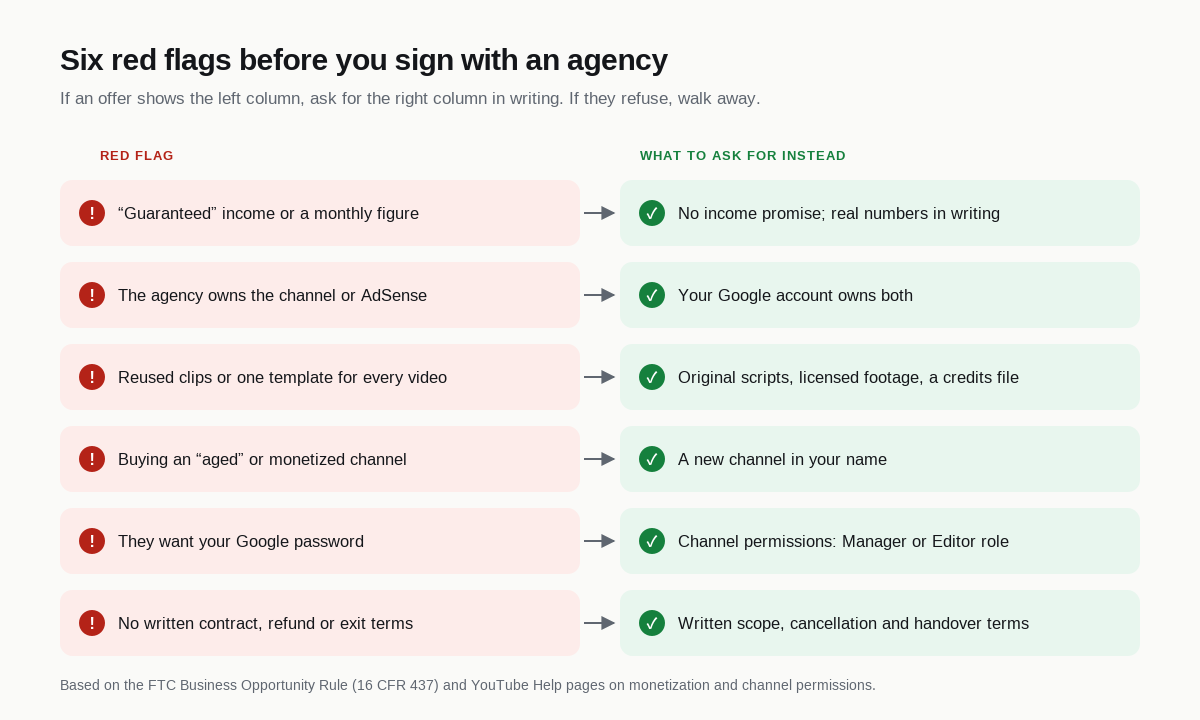
Guaranteed income
No agency controls YouTube's algorithm or ad rates. A promise like "$10K a month in 90 days" is a sales claim, not a forecast. Watch for softer versions too: a "guaranteed monetization roadmap" is a plan, not a promise of monetization.
Channel or AdSense ownership
If the agency creates the channel under its own Google account, you're renting it. YouTube's channel Owner role "can't transfer ownership to other users", and AdSense terms "don't permit transfers of account ownership" (YouTube Help). Create the channel and the AdSense account yourself, then invite the agency.
Reused or templated content
YouTube's monetization policies don't pay for "inauthentic" content (mass-produced, generic or templated) or for reused content, and reused content is judged "at the channel level". An agency running 50 channels from one template puts every client at risk. AI itself is allowed, but realistic AI content must be disclosed.
Buying channels or engagement
Some agencies sell "aged" or already-monetized channels. YouTube's Terms of Service have no clause that explicitly allows or bans this. But a bought channel carries its old strikes and history, and the Owner role can't be transferred. Under the monetization policies, penalties "may apply to all of your existing channels". Bought views or subscribers break the fake engagement policy, which can end in termination.
Password requests and no paperwork
An agency asking for your password, or working without a written scope, is a sign of how it will handle problems later. Channel permissions exist so you never share a login.
What the FTC says about earnings claims
In the US, the FTC's Business Opportunity Rule (16 CFR Part 437) covers many "make money" offers where a seller takes a payment and claims to provide, for example, accounts or outlets. Whether a given agency falls under it depends on the offer. Either way, its requirements make a good checklist for any seller who talks about income:
- A one-page disclosure document, given at least 7 days before you sign or pay.
- Legal actions from the past 10 years, the refund policy, and at least 10 past buyers as references.
- Any earnings claim in a separate Earnings Claim Statement, with the dates, and the number and percentage of buyers who earned at least that much.
- Written substantiation for the claim, held when the claim is made.
The FTC acts on AI-flavoured income schemes. In February 2024 it banned the operators of Automators AI, which promised "passive" income from AI-powered online stores, from selling business opportunities, with a judgment of $21,765,902.65 (FTC). That case was about e-commerce, not YouTube, but the pattern of passive-income promises, AI hype and accounts suspended by the platform is the one to avoid. If a YouTube agency quotes income, ask for its earnings claim statement. A seller with real numbers can produce one.
The in-house alternative: AI plus one editor
For faceless documentary and explainer channels, most of what an agency's team does can now be done by AI under your control. VidGenn turns a topic or your own script into a finished documentary of 3 to 20 minutes, in 1080p. It writes a researched script you can edit line by line and narrates it with one of 24 ElevenLabs voices. It then matches licensed real footage from NASA, Wikimedia Commons, Internet Archive, Pexels and Pixabay to every sentence, with a credits file. A motion graphic lands on every fact.
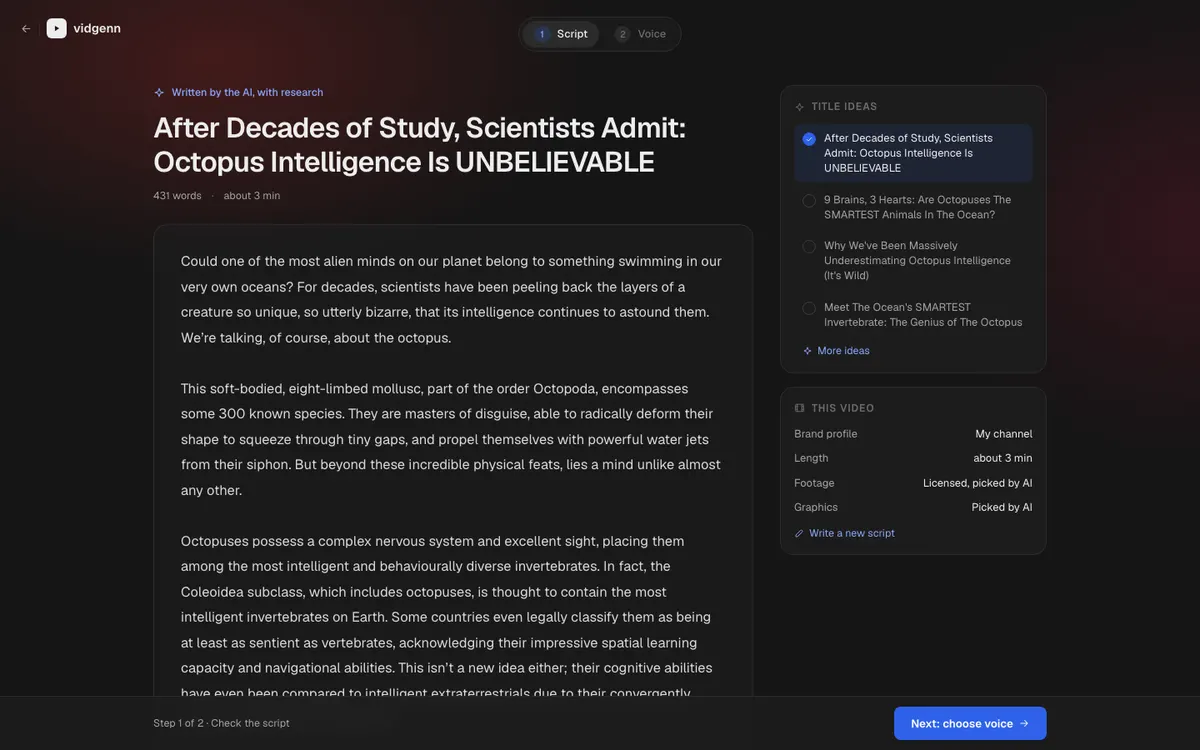
What it doesn't do matters for this decision. VidGenn makes documentary and explainer videos only, with no presenters or talking heads. It doesn't make thumbnails or Shorts, and it doesn't upload to YouTube. So the realistic in-house setup is VidGenn for the first cut, one editor for thumbnails, Shorts and polish, and you for publishing. Our guide on how to hire a faceless YouTube video editor covers that hire.
Worked example: 8 ten-minute videos a month (our arithmetic)
- VidGenn: 8 × 10 = 80 minutes, inside the Pro plan's 180 minutes, so $79 a month.
- Editor: 8 videos × 2 hours of polish and thumbnails × $35 an hour = $560. The $35 is Upwork's published median for video editors; the 2 hours is our estimate.
- Total: $79 + $560 = $639 a month, or $639 ÷ 8 = about $80 per video.
- Agency comparison: Tasty Edits' 8-video editing pack (8 × $278 = $2,224) plus Starter management ($1,490) = $3,714 a month. ZAN starts at $499, but its scope for that price isn't published.
Break-even is the other half of the sum. Views needed = monthly cost ÷ RPM × 1,000. With a hypothetical $5 RPM, $639 needs 127,800 views a month (639 ÷ 5 × 1,000), and $3,714 needs 742,800. Your RPM will differ, so plug in your own; our guide on whether faceless channels make money explains RPM.
An agency does better in some cases. If you want talking-head or gaming content, need languages VidGenn doesn't narrate (ZAN lists Urdu and Hindi), or have no time to review scripts, a good agency is the better fit. Where in-house wins: cost per video, control of every script, and no lock-in.
Agency or in-house: how to decide
| Your situation | Better fit |
|---|---|
| You have money but almost no time, and want talking-head or gaming content | An agency with a written scope |
| You run a faceless documentary or explainer channel and can spend a few hours a week reviewing | In-house: AI plus one editor |
| You're testing a niche for the first time | In-house, so a failed test costs tens of dollars, not thousands |
| You run five or more channels | In-house with an editor team, or an agency per channel with strict terms |
Whichever you pick, YouTube's bar doesn't change: 1,000 subscribers plus 4,000 watch hours in 12 months or 10 million Shorts views in 90 days for the Partner Program. From 1 February 2027, new applicants need 8,000 hours or 20 million Shorts views (YouTube Help). Our step-by-step guide to getting monetized covers both.
Common questions
Are YouTube automation agencies legit?
Some are real production businesses and some sell income dreams. The test is the paperwork: a written scope, your ownership of the channel and AdSense, access by channel permissions, and no guaranteed income. Read our red flags before any call.
How much does a YouTube automation agency charge?
Few publish prices. ZAN starts at $499 a month, Tasty Edits' channel management costs $1,490 to $2,370 a month before editing, and YT Wealth Media asks you to contact it. Compare these with our cost per video guide.
Do agencies take a share of channel revenue?
None of the three we read publishes a revenue share. Some offers do include one. If so, get the percentage, the income it covers and the end date in the contract.
Can YouTube demonetize a channel run by an agency?
Yes. The policies apply to the channel, not to who made the videos. Reused or mass-produced content isn't monetizable, and agency terms usually exclude liability for demonetization. See can you monetize AI documentaries.
Is it cheaper to do YouTube automation yourself with AI?
For faceless documentary channels, usually. In our example, eight 10-minute videos cost about $639 a month with VidGenn Pro and an editor, against $3,714 for an editing pack plus management. It costs you review time instead. See how to scale YouTube automation.