ElevenLabs is an AI voice company whose text-to-speech turns a written script into natural-sounding narration. To use it for YouTube videos you can monetize, you need a paid plan: the free plan has no commercial license and makes you put “elevenlabs.io” or “11.ai” in the video title. The cheapest paid plan, Starter at $6 a month, includes a commercial license and 30,000 credits, which is about three 10-minute narrations. A channel posting one 10-minute video a week fits Creator ($22 a month, 121,000 credits) with room for retakes.
This guide covers what each plan gives a YouTube channel, the commercial-use rules and how to turn a script into credits. It also covers the Voice Library versus voice cloning, settings for calm narration, and when YouTube asks you to label an AI voice. VidGenn, which publishes this guide, builds 24 ElevenLabs narrators into its documentary maker, so the last section compares the two routes fairly. If you're still planning the whole channel, start with how to make faceless YouTube videos with AI.
How we checked: plans, credits and rights come from the ElevenLabs pricing page, its documentation and its help center; the labelling rules come from YouTube Help. We read every page on 18 November 2026, in US dollars with monthly billing. The minutes-per-video arithmetic is ours and is shown in full.
Key takeaways: (1) The free plan can't be used commercially, so a monetized channel needs Starter ($6, 30,000 credits) or higher. (2) A 10-minute script of about 1,450 words is roughly 8,700 characters, which is 8,700 credits on a 1-credit-per-character model. (3) You can only clone your own voice: ElevenLabs says that even with consent, you cannot make a Professional Voice Clone of someone else. (4) YouTube wants a label when a real person appears to say something they didn't, but cloning your own voice for voiceovers counts as a minor change.
Which ElevenLabs plan do you need for YouTube?
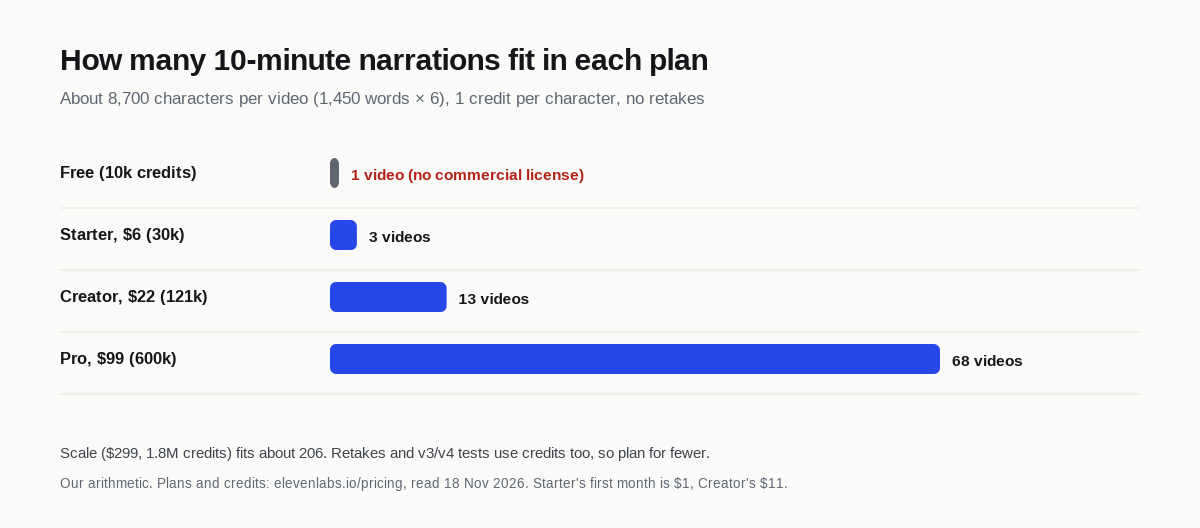
ElevenLabs sells credits. On the standard text-to-speech models, one character of your script costs one credit, so the plan you need depends on how many characters you narrate a month. Here are the plans as listed on the pricing page:
| Plan | Price a month | Credits a month | Commercial license | Voice cloning | Fits (10-min videos) |
|---|---|---|---|---|---|
| Free | $0 | 10,000 | No | None | 1, but not for monetized use |
| Starter | $6 ($1 the first month) | 30,000 | Yes | Instant clones | About 3 |
| Creator | $22 ($11 the first month) | 121,000 | Yes | Instant + 1 Professional clone | About 13 |
| Pro | $99 | 600,000 | Yes | Instant + 1 Professional clone | About 68 |
| Scale | $299 | 1,800,000 | Yes | Instant + 3 Professional clones | About 206 |
| Business | $990 | 6,000,000 | Yes | Instant + 10 Professional clones | About 689 |
Yearly billing gives two months free, so Creator works out to about $18.33 a month and Pro to $82.50. Creator and above also add 192 kbps audio as well as 128 kbps; Free and Starter are 128 kbps only. For a YouTube voiceover, 128 kbps is fine, since YouTube re-encodes the audio anyway.
Rule of thumb: one 10-minute video a week fits Creator with plenty of room for retakes. A daily channel, or an agency voicing several channels, needs Pro or Scale. Starter suits a channel that posts two or three videos a month and rarely regenerates a line.
Can you monetize YouTube videos that use ElevenLabs?
Yes, on any paid plan. The ElevenLabs help center says all paid plans include a commercial license, as long as you have the rights to what you narrate and follow its terms and use policy. A monetized YouTube channel is commercial use, because it earns from ads, memberships and sponsors.
- Free plan: no commercial license. If you share free-plan audio non-commercially, you must credit ElevenLabs by putting “elevenlabs.io” or “11.ai” in the title. That rules it out for a channel in the Partner Program.
- Paid plans: commercial use is allowed, and the help center says content made during a paid subscription can be used commercially indefinitely, subject to its service-specific terms.
- After you cancel: anything generated outside a paid subscription, before or after, is non-commercial and needs attribution. Generate every line you'll need before you downgrade.
- Beta features: audio made with features ElevenLabs labels as beta can't be used commercially at all, even on a paid plan.
The license covers the voice, not your script or footage. YouTube still judges the video as a whole, and it won't monetize mass-produced or templated content, however good the narrator sounds. Our guide to monetizing AI documentaries covers what reviewers look for.
How many minutes of narration does each plan give?
ElevenLabs' own pricing page gives rough minutes: about 10 minutes on Free, 30 on Starter, 121 on Creator and 600 on Pro. That's about 1,000 credits per minute of audio. Documentary narration usually runs a little lower, because a calm narrator speaks at about 145 words a minute.
Credit costs also depend on the model. On the pricing page, Eleven Multilingual v2 costs 1 credit per character, while the faster Flash and Turbo models cost 0.5 to 1 credit per character for API use. Some Voice Library voices carry a credit multiplier, so a 2x voice uses twice the credits. And every regenerated line costs credits again, which is where most budgets go.
Worked example: from script to plan
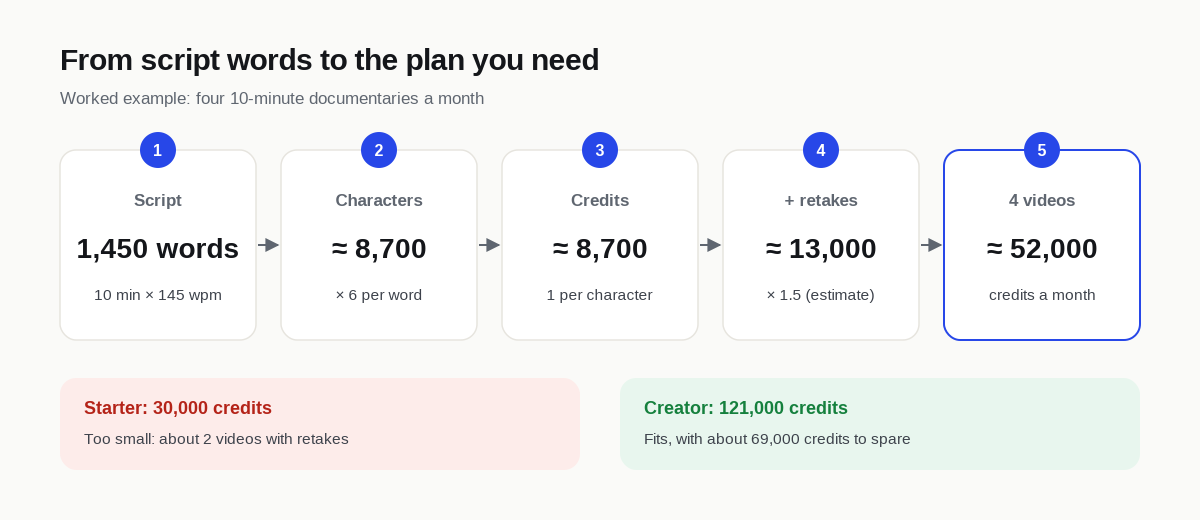
Say you run a history channel and publish four 10-minute documentaries a month. Here is the arithmetic (ours, using the pricing page's 1 credit per character):
- Words: 10 minutes × 145 words a minute = 1,450 words per script.
- Characters: English averages about 6 characters per word once you count spaces and punctuation, so 1,450 × 6 ≈ 8,700 characters. This is an estimate; paste your script into any character counter for the real number.
- Credits: 8,700 characters × 1 credit = 8,700 credits per video.
- Retakes: you'll regenerate some lines for a wrong stress or a name. Allow 50% extra (our estimate): 8,700 × 1.5 ≈ 13,000 credits per video.
- Month: 4 videos × 13,000 = 52,000 credits.
Starter's 30,000 credits cover only about two of those videos. Creator's 121,000 credits fit all four, with about 69,000 left over for tests, Shorts voiceovers or a fifth video. On yearly billing that's $18.33 a month for the voice, or about $4.58 per video.
Voice Library or your own voice clone?
You have three sources of voices, and they suit different channels.
Ready-made and Voice Library voices
The Voice Library is a marketplace where people share Professional Voice Clones of their own voices and earn when others use them. Saving one doesn't use a custom voice slot. Two details matter for a channel that will use one voice for years:
- Notice period: an owner can stop sharing a voice. If they set a notice period (30 days to 2 years, per the docs), you keep access for that long. If they set none, the voice disappears at once. Pick a voice with a long notice period for a channel's signature narrator.
- Cost: some voices are only for paid subscribers, and some carry a credit multiplier. Check the voice card before you voice a whole series with it.
Instant Voice Clone (your voice, fast)
An Instant Voice Clone needs 1 to 2 minutes of clean audio, and ElevenLabs says more than 2 to 3 minutes adds little (voice cloning docs). It's included from Starter. It sounds like you, but less exact than a professional clone.
Professional Voice Clone (your voice, trained)
A Professional Voice Clone needs 30 to 180 minutes of clean audio and trains in about 3 to 6 hours. It needs Creator or above, and you must pass a voice check proving the voice is yours. ElevenLabs is blunt about the limit: “Even with their consent, you cannot clone someone else's voice.” If a partner or a hired narrator wants to be your channel voice, they make and verify their own clone, then share it with you.
Which to choose: a library voice is quickest and costs nothing extra. A clone of your own voice is worth it if your face-free channel still wants a personal brand, or if you also record some videos yourself and need them to match.
Best ElevenLabs settings for documentary narration
ElevenLabs says the voice you pick matters most, then the model, then the settings. Its text-to-speech guide gives these starting points, and they suit a calm documentary read:
| Setting | Start at | What it does for narration |
|---|---|---|
| Model | Multilingual v2 (or v4) | ElevenLabs calls Multilingual v2 its most stable model on long-form generations; v4 is the newest, with 90+ languages |
| Stability | About 50 | Higher sounds steadier and more serious; lower adds emotion but can wander |
| Similarity | About 75 | How closely it follows the original voice; very high values can distort |
| Style | 0 | ElevenLabs recommends keeping it at 0; it can make the voice less stable |
| Speed | 1.0 (range 0.7 to 1.2) | Slow to 0.9 for a heavy topic; values outside the range can hurt quality |
A few habits keep a 10-minute read consistent:
- Use Studio for long scripts. The website generates up to 10,000 characters at a time on v4 and 5,000 on other models, so a 10-minute script needs at least one split. ElevenLabs recommends its Studio editor for long-form work.
- Generate by chapter, not one paragraph at a time. Fewer joins means fewer changes in tone.
- Listen for hard names. Local place names and Latin species names are where a narrator is most likely to stumble; respell them the way they sound and regenerate that line.
- Write numbers out where it matters. A year or a big figure can be read more than one way; “nineteen fourteen” or “two million” leaves no doubt.
- Keep the settings in a note with the voice name, so every video in a series sounds the same.
For pacing and how to write for the ear, see how to write a documentary script for YouTube.
Do you have to label an ElevenLabs voice on YouTube?
Usually not, but it depends on whose voice it is. YouTube's altered or synthetic content rules ask you to disclose realistic content that “makes a real person appear to say or do something they didn't do.” A cloned voice of a real person saying new words falls squarely there. And ElevenLabs won't let you clone someone else's voice anyway.
The same page lists “cloning one's own voice to create voice overs or dubs” as a minor change that needs no label. Using AI to write or improve a script is also on the minor list. The page doesn't name stock AI narrators directly. A library narrator reading your documentary doesn't impersonate anyone, which puts it closer to the minor examples. If you're unsure, ticking “altered or synthetic content” when you upload costs you nothing.
When the label applies to AI audio that isn't music, YouTube says it may show in the expanded description rather than on the player.
ElevenLabs on its own, or a tool with ElevenLabs voices built in?
ElevenLabs gives you narration only. You still need a script, footage you're allowed to use, graphics, music and an edit. There are two ways to get there.
| ElevenLabs + your own edit | VidGenn (ElevenLabs voices built in) | |
|---|---|---|
| What you pay for | Voice only: Creator $22 a month | The finished video: Creator $38 for 60 minutes |
| Voices | Whole Voice Library, plus your own clone | 24 ElevenLabs narrators; no uploads of your own voice |
| Script | You write it | Researched draft, every line editable, or paste your own |
| Footage | You find, license and log it | Licensed real footage for every sentence, with a credits file |
| Graphics | You make them | A motion graphic on every fact |
| Best for | Channels with an editor, or a cloned voice | Faceless documentaries without an editor |
To be fair to the first route: if you already have an editor and a footage workflow, ElevenLabs alone is cheaper per video, and only it lets you narrate in your own cloned voice. The cost of that route is the edit. Our AI tools for faceless channels guide lists what the rest of the stack costs.
VidGenn makes 3 to 20-minute documentaries as 1080p MP4s, narrated in English, Portuguese, Spanish, French, German or Italian. Minutes are the length of the finished video, so a 10-minute video costs about $6.30 on Starter or Creator, $4.40 on Pro and $3.00 on Studio. Edits and re-renders don't use minutes. It's documentary style only: no avatars, no Shorts, no thumbnails, and it doesn't upload to YouTube for you. See script to video AI for how it reads your own script word for word.
Common questions
Can I use ElevenLabs free for YouTube videos?
Only for videos that earn nothing, and you must put “elevenlabs.io” or “11.ai” in the title. The free plan has no commercial license, so a monetized channel needs Starter ($6 a month) or higher. See how to get monetized on YouTube for the rest of the rules.
Which ElevenLabs plan is best for a faceless YouTube channel?
Creator, for most weekly channels: 121,000 credits fit about 13 ten-minute narrations before retakes. Starter (30,000 credits) suits two or three videos a month. Pro (600,000) suits daily uploads or several channels.
How many characters is a 10-minute YouTube video?
About 8,700, by our estimate: 10 minutes × 145 words a minute = 1,450 words, at about 6 characters per word including spaces. On a 1-credit-per-character model, that's about 8,700 credits.
Can I clone a celebrity's or narrator's voice for my channel?
No. ElevenLabs only lets you professionally clone your own voice, even if the other person agrees. A narrator who wants to work with you can clone and verify their own voice and share it. Realistic AI showing a real person saying things they didn't must also be labelled on YouTube.
Will YouTube demonetize videos with AI voices?
Not for the voice itself. YouTube refuses mass-produced, templated and reused content, whatever the voice. Original research, a real story and licensed footage are what pass review; see do faceless YouTube channels make money.