A good YouTube documentary script opens with a hook that promises an answer, tells one story in three to five beats, and pays the promise off at the end. Write it for the ear, in short sentences with one idea per paragraph, at about 130–150 words per minute of video, and check every fact in two sources.
Below: the structure, how to write the hook, how to research, how long the script should be, and how to write facts that become on-screen graphics. The examples come from a real script about octopuses, as VidGenn's AI drafted it and after a human edit.
The structure that works
Most documentary videos that hold attention follow the same shape. It is not a formula for the words, only for where the viewer's questions get answered.
| Part | In a 10-minute video | Its job |
|---|---|---|
| Hook | 15–30 seconds | Ask the question or show the contradiction, and promise the answer |
| Context | 1–2 minutes | Only what the viewer needs: the place, the time, the people |
| Beats (3 to 5) | 6–7 minutes in total | Each one answers part of the question and raises the next |
| Payoff | About 1 minute | The answer, and why it matters |
| Outro | 15–30 seconds | One line that points to the next video, not a long goodbye |
The beats carry the video. End each one on an open question ("but that raised a bigger problem") so there is always a reason to keep watching.
Example: a beat sheet for a 10-minute video
Before writing sentences, write the beats: what each part answers and which facts it shows. Here is the outline of an octopus documentary, close to the structure of VidGenn's octopus example.
| Time | Beat | The question it answers | Facts to show |
|---|---|---|---|
| 0:00–0:20 | Hook | Where does an octopus think? | More than 500 million neurons, most outside the head |
| 0:20–1:45 | Context | What is this animal? | About 300 species; no bones, three hearts, blue blood |
| 1:45–4:00 | Beat 1: arms that think | How can an arm decide on its own? | Over two thirds of neurons in the arms and body |
| 4:00–6:00 | Beat 2: tools | Do octopuses use tools? | 2009 study: coconut shells carried as shelter, Bali and North Sulawesi |
| 6:00–8:00 | Beat 3: escapes | How clever is clever? | Opening jars; Inky's escape from New Zealand's National Aquarium in 2016 |
| 8:00–9:30 | Payoff | So what are they? | UK law recognises them as sentient: Animal Welfare (Sentience) Act 2022 |
| 9:30–10:00 | Outro | What next? | One line pointing to a related video |
Every beat has a question, and every question gets a fact you can put on screen. The writing then becomes filling in the beats, not deciding what the video is about.
Write the hook last
You only know the most surprising thing in the story after you have written it, so write the hook last. A strong hook does three things in two or three sentences: it states something concrete, it creates a gap ("how?", "why?"), and it promises the video will close it.
Here is the opening VidGenn's AI wrote for the octopus video, unedited:
"Could one of the most alien minds on our planet belong to something swimming in our very own oceans? For decades, scientists have been peeling back the layers of a creature so unique, so utterly bizarre, that its intelligence continues to astound them."
It is a fair draft: a question, a promise. But it is vague ("so unique, so utterly bizarre") and it takes two sentences to say nothing specific. The edited version leads with a fact that is hard to believe:
"An octopus has more than 500 million neurons, and most of them aren't in its head. They're in its arms. Each arm can touch, taste and react on its own. So what is it like to think with your whole body?"
Same topic, same length. The second one gives a number, a surprise and a question the video has to answer. (The facts come from the Okinawa Institute of Science and Technology: "over 500 million neurons", with "over two thirds" in the arms and body.)
Research: two sources for every number
One wrong fact in the comments can sink a video's credibility. A simple routine prevents most errors:
- Use Wikipedia as a map, not a source. Read the article to understand the story, then follow its references to the studies, archives and books it cites.
- Check every number in two independent places. If they disagree, use the more careful source and say "about" or "more than".
- Write down the source next to each fact in your research notes. You will need it for the description, and when a viewer asks.
- Quote people from the original. A quote copied from a quote site is often wrong or misattributed.
- Watch for dates. Studies get updated; a "latest" figure from 2015 may not be the latest any more.
Example: the 2009 coconut-carrying octopus is a well-known story. The original paper is Finn, Tregenza and Norman, "Defensive tool use in a coconut-carrying octopus", in Current Biology, and the octopuses were observed in Bali and North Sulawesi, Indonesia. That is the level of detail to keep in your notes.
Write for the ear, not the page
Viewers hear the script once, at the narrator's speed. They can't re-read a sentence. That changes how you write:
- Keep sentences short. Most under 20 words. A long sentence makes the narrator rush or run out of breath.
- Write numbers the way they are said. "More than 500 million", not "5 × 10⁸". Round where precision doesn't matter.
- Skip parentheses, footnotes and abbreviations. They don't survive being read aloud.
- Name things before you use "it" or "they". On the page the noun is two lines up; in audio it is gone.
- One idea per paragraph. Each paragraph usually becomes one or two shots, so it also makes the edit easier.
- Read it aloud. Every place you stumble, a narrator will too.
How long should the script be?
Documentary narration usually runs at 130–150 words a minute. VidGenn's narrators average about 130, so its studio estimates a video's length at 130 words a minute.
| Video length | Words at 130 a minute | Words at 150 a minute |
|---|---|---|
| 5 minutes | 650 | 750 |
| 8 minutes | 1,040 | 1,200 |
| 10 minutes | 1,300 | 1,500 |
| 15 minutes | 1,950 | 2,250 |
| 20 minutes | 2,600 | 3,000 |
Write to the story, not to the number. If the story is done at 7 minutes, publish 7 minutes; padding is the fastest way to lose viewers halfway through.
Write facts that can be shown
In the faceless documentaries we measured, a designed graphic appeared every 10–15 seconds, nearly always on the sentence that states a number, a date, a place or a name. You can plan for that in the script: about every 25–35 words, include one fact that can be put on screen.
| Sentence in the script | Graphic on screen |
|---|---|
| "An octopus has more than 500 million neurons." | A big number: 500 MILLION |
| "Most of them sit in its arms." | A percentage ring |
| "In 2009, researchers published film of octopuses carrying coconut shells." | A year card: 2009 |
| "They were observed in Bali and North Sulawesi, in Indonesia." | A map with both places marked |
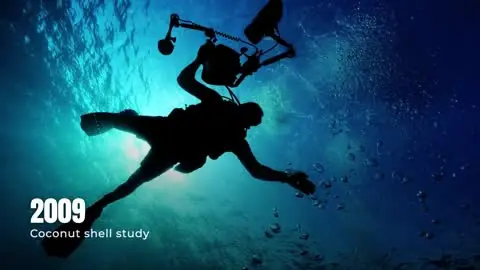
A sentence like "it is truly remarkable" gives the editor nothing to show. A sentence with a number gives them a graphic. VidGenn's motion library shows the kinds of graphics that fit each type of fact.
Five mistakes that lose viewers
- A slow start. "Welcome back to the channel, today we're going to talk about…" spends the 15 seconds that decide whether people stay. Start with the hook.
- Superlatives instead of facts. "Incredibly intelligent" says nothing. "Can open a screw-top jar from the inside" shows it.
- A list instead of a story. Ten facts in a row feel like a slideshow. Connect them with the question each one answers.
- Hiding the best fact without promising it. Keep the strongest fact for the payoff if you like, but promise it early so people wait for it.
- Numbers without a comparison. "500 million neurons" means little alone. "About as many as a dog" (the comparison OIST uses) makes it stick.
Match the title to the hook
The title and the first 15 seconds make one promise together. If the title asks a question, the hook should restate it in the first sentence. Patterns that work for documentaries:
- A number with stakes: "The 16 Weeks That Saved Britain"
- A contradiction: "How the Everglades Actually Flows (The River, Not the Swamp)"
- A why-question about something strange: "Why Does Russia Own Land Between Poland and Lithuania?"
- A superlative you can prove: "33,500 Feet: The Real Tallest Mountain on Earth"
Using AI to draft the script
AI is good at the first draft: gathering the facts, proposing a structure, writing a version you can react to. YouTube's rules on synthetic content say that using generative AI to "create or improve a video outline, script" does not need a disclosure label.
The risk is sameness. YouTube's inauthentic content policy does not monetize "AI-generated content made with generic or unoriginal templates giving the impression of mass production", and says the final product must still demonstrate your creative vision. So edit every draft: check each fact, cut the generic sentences, and add the angle that makes the video yours.
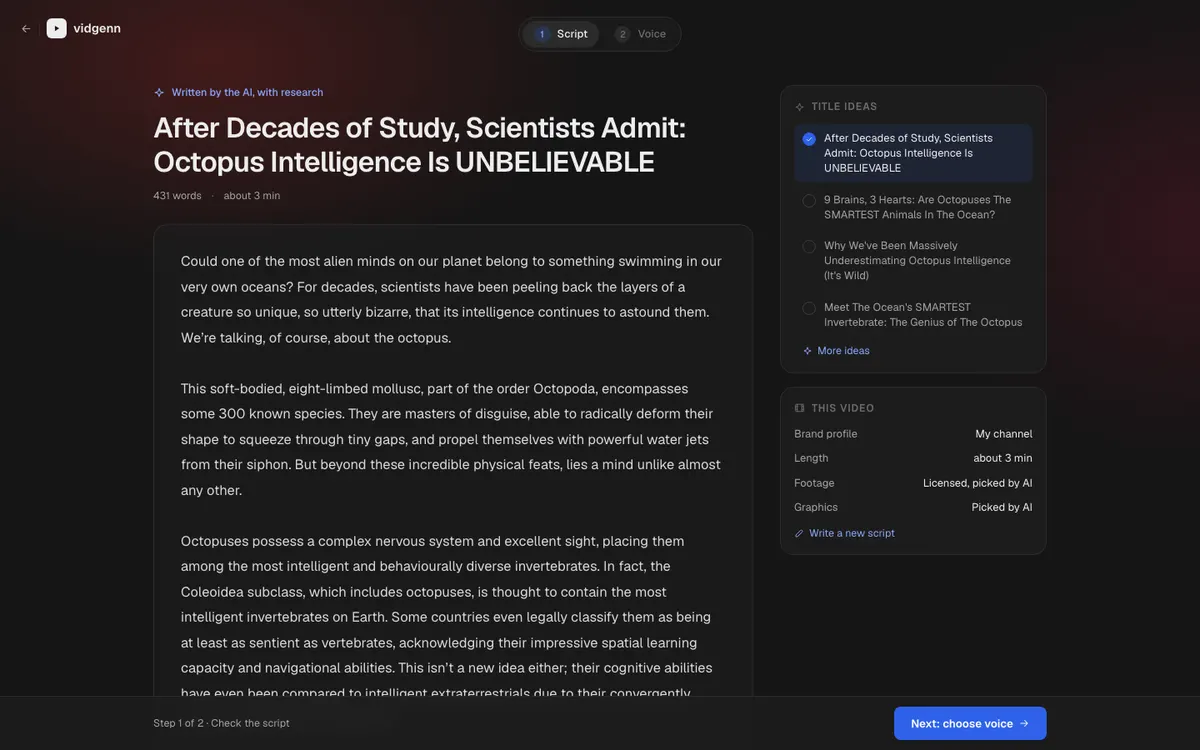
In VidGenn, the AI researches the topic and drafts the script and four title ideas in about a minute; you then edit every line before anything is made. Or you paste your own script, and it is read word for word.
Script checklist
- The first two sentences contain a concrete fact and an open question.
- Each beat ends on a reason to keep watching.
- Every number is checked in two sources, and the sources are in your notes.
- Most sentences are under 20 words; you read it aloud once.
- There is a showable fact about every 25–35 words.
- The length matches the story: no padding.
- The title and the hook make the same promise.