A cash cow YouTube channel is a faceless channel run as a business: the owner pays writers, narrators, editors or AI tools to make the videos, and earns from ads, sponsors and affiliate links. It's a real model, but not a passive one. What a channel earns comes down to views times RPM, and the median RPM in one large dataset ranged from $0.33 to $10.22 depending on the niche. Nobody can promise you an income from it.
This guide explains where the term comes from, how these channels make money and what realistic numbers look like. It also covers good and risky niches, what it costs to start, and the YouTube rule changes of 2025 and 2027. It ends with a step-by-step start and a warning about courses. VidGenn, which makes faceless documentary videos, publishes this guide.
How we checked: YouTube rules come from YouTube Help, read on 18 November 2026. RPM figures are from AIR Media-Tech's published dataset (300 channels, May 2025 to May 2026). Freelancer prices are Upwork's published ranges. All earnings figures here are arithmetic examples, not predictions.
Key takeaways: (1) Ad revenue = views ÷ 1,000 × RPM; at 100,000 views a month that's about $33, $230 or $1,022 at three niche medians. (2) No ads pay until the Partner Program: 4,000 watch hours today, 8,000 for new applicants from 1 February 2027. (3) Since 15 July 2025, YouTube calls mass-produced, templated videos "inauthentic content" and doesn't pay for them. (4) A start with AI tools costs from about $19 a month; a freelance video can cost $925 or more.
What is a cash cow YouTube channel?
"Cash cow" is community slang, not a YouTube term. It describes a channel where the owner never appears on camera and treats the channel like a small media business. The owner picks the niche and topics, pays for production, and manages the channel's growth. Common formats are documentaries, explainers, top-10 lists and history or science stories.
It overlaps almost entirely with YouTube automation, which our YouTube automation with AI guide explains. The difference is mostly tone: "cash cow" tends to be used by people selling the idea as easy money. It isn't easy, and the rest of this guide shows why.
Cash cow channel vs a personal channel
| Cash cow (faceless) channel | Personal channel | |
|---|---|---|
| Who's on screen | Nobody: narration over footage and graphics | The creator |
| What viewers come for | The topic | The person |
| Who makes the videos | Freelancers, an agency or AI tools, managed by the owner | Mostly the creator |
| Main income | Ads first, then sponsors and affiliates | Ads, sponsors, products, memberships |
| Can it be sold or handed over? | More easily, since no face is attached | Hard |
| Main risk | Videos that look mass-produced | Burnout of one person |
The topic-first nature is the model's strength and its weakness. Viewers don't follow a personality, so each video has to win on its own title, thumbnail and story. That's why packaging and research matter more here than on almost any other kind of channel.
How do cash cow channels make money?
There are three main income streams. Ads come first for most channels; the other two need an audience first.
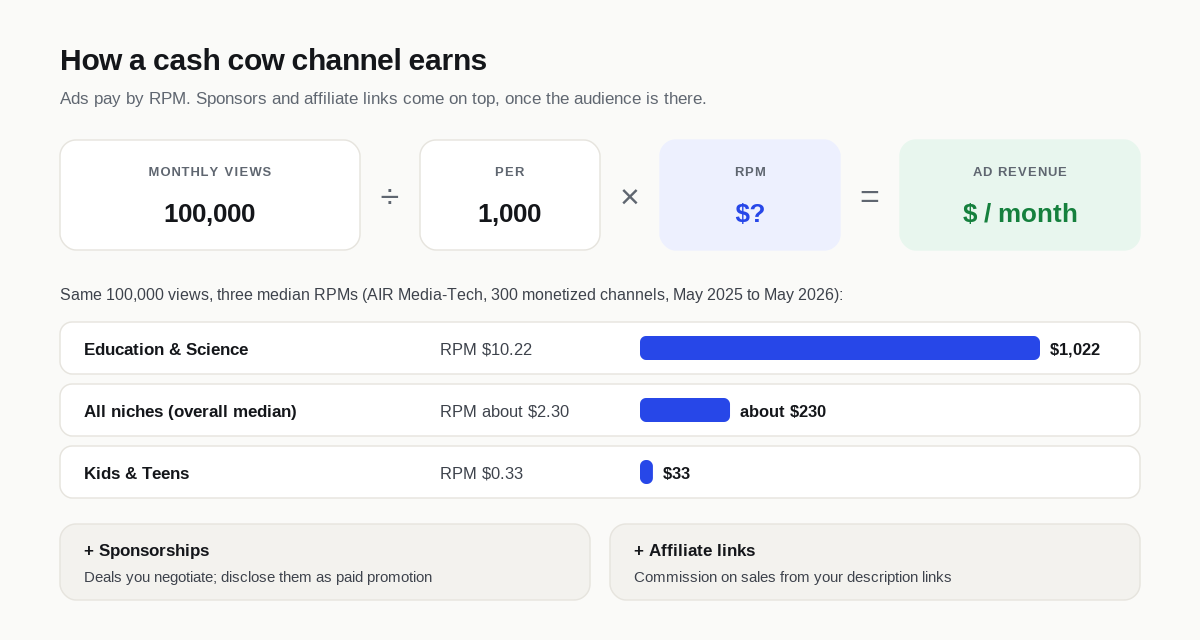
- Ads. Once a channel joins the YouTube Partner Program, YouTube pays it 55% of net revenue from ads on its long-form videos (YouTube Help). What you see per 1,000 views is your RPM.
- Sponsorships. Brands pay for a mention or segment. You must tell YouTube by ticking the paid promotion box in the video details (YouTube Help), which adds a disclosure label.
- Affiliate links. You earn a commission when viewers buy through links in your description. Programs and rates vary by retailer.
Sponsors and affiliates usually come later. Brands look for a steady audience in a clear niche, and affiliate sales need viewers who trust the channel's picks. A history channel might link books on its topics; a science channel might link telescopes or kits. Keep the links relevant to the video, or they read as spam. Shopping affiliate features on YouTube itself need the channel to be in the Partner Program.
How much does a cash cow channel really make?
YouTube defines RPM as "how much money you've earned per 1,000 video views", after YouTube's share and counting views that weren't monetized (YouTube Help). YouTube doesn't publish RPM by niche. The clearest public data we found is AIR Media-Tech's: 300 channels, 3,595 monetized channel-months, May 2025 to May 2026.
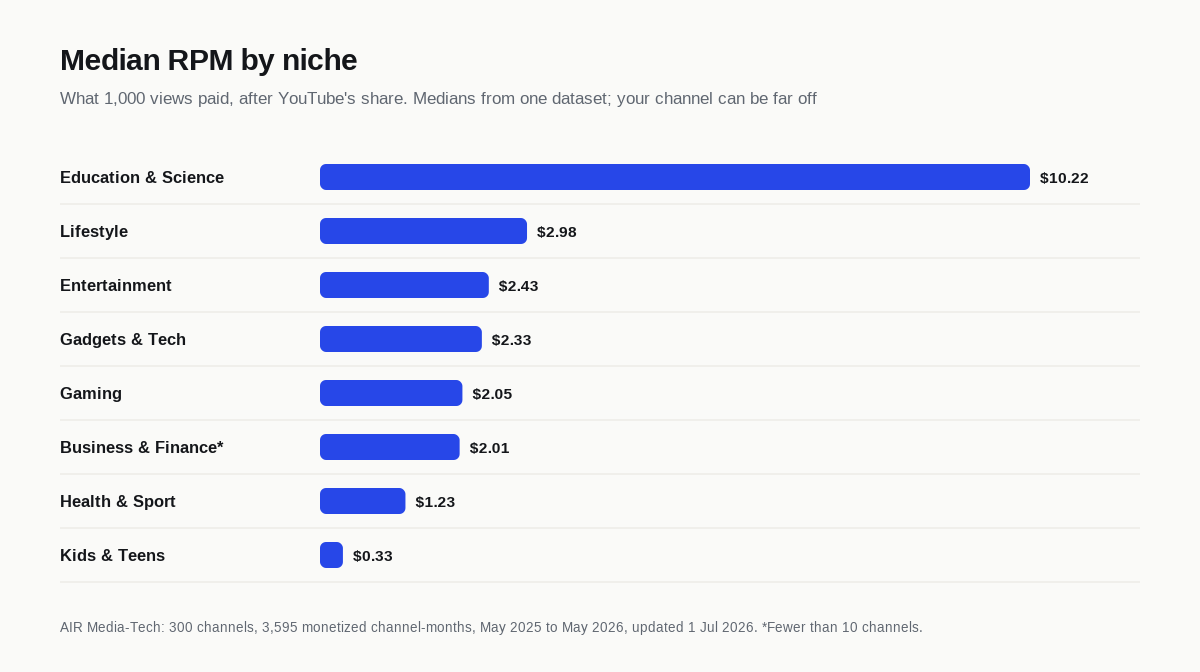
Medians hide a wide spread. Within Education & Science, the middle half of results ran from $2.31 to $19.50. Audience country, video length and the time of year all move RPM. Treat these as a starting point for your own arithmetic, not as a forecast.
Worked example (our arithmetic): a channel getting 100,000 views a month at the Education & Science median of $10.22 earns 100,000 ÷ 1,000 × $10.22 = $1,022 in a month. At the all-niche median of about $2.30, the same views earn about $230. At the Kids & Teens median of $0.33, $33. Same work, about a 30-fold difference.
Now set that against cost. Ten 10-minute videos a month at the low end of Upwork's freelance ranges cost about $9,250 (our per-video guide shows the lines). At $10.22 RPM that needs about 905,000 views a month to break even. On VidGenn Pro the same ten videos cost $79 in minutes, which needs about 7,700 views (thumbnails and your time extra). This is why the cost route matters as much as the niche. More examples are in do faceless channels make money.
The YouTube rules that changed in 2025 and 2027
July 2025: "inauthentic content"
On 15 July 2025 YouTube renamed its "repetitious content" policy to inauthentic content. The monetization policies don't pay for "similar or repetitive content with low educational value, commentary, narratives, or minimal variation across videos". They also exclude "image slideshows, templated storylines, or scrolling text" without real narrative, and "AI-generated content made with generic or unoriginal templates giving the impression of mass production". Reused content, taken from elsewhere without substantive changes, isn't paid either.
AI tools are allowed. When you use automated tools or templates, the same page says "the final product must still demonstrate your creative vision." Realistic AI content (a real person saying something they didn't, a realistic event that never happened) has to be labelled at upload (YouTube Help). The old cash cow playbook of one template and daily uploads is exactly what these rules target.
February 2027: a higher bar for new channels
Today the Partner Program needs 1,000 subscribers plus 4,000 public watch hours in 12 months, or 10 million Shorts views in 90 days. From 1 February 2027, new applicants need 8,000 watch hours or 20 million Shorts views (YouTube Help). Channels already in the program keep their status but must stay active. A channel you start today will likely apply under the new rules, so plan for 8,000 hours. Our monetization guide explains both.
Worked example: how many videos to reach 8,000 watch hours?
Because a new channel will likely apply under the 2027 rules, it helps to turn 8,000 hours into views and videos. This is our arithmetic, with assumptions you should swap for your own.
- Views needed: 8,000 hours × 60 minutes ÷ 4 minutes average view = 120,000 views in 12 months.
- Views per video: if each 10-minute video averages 2,000 views in its first year, you need 120,000 ÷ 2,000 = 60 videos.
- Pace: 60 videos in 12 months is about 5 a month, a little over one a week.
- Cost of that library: 60 × $4.40 = $264 in VidGenn Pro minutes, or 60 × $925 = $55,500 with low-end freelancers, before thumbnails.
Change one input and the answer moves a lot. A 6-minute average view cuts the views needed to 80,000; 500 views a video raises the count to 240 videos. That's why average view duration is the number to improve first. Our watch hours chart shows other combinations.
Good niches and risky niches
| Niche type | Why | Risk level |
|---|---|---|
| History, science, space, geography documentaries | Evergreen searches, education-style RPMs, lots of public-domain footage | Lower, if each video is researched |
| Explainers and top-10 lists on real topics | Easy to vary; strong search demand | Medium: lists drift into templates |
| Finance and business | Advertisers pay well, but AIR's median was only $2.01 (small sample) | Medium: accuracy and advice rules |
| Kids content | AIR's median RPM was $0.33; made-for-kids rules limit features | High for earnings |
| Clip compilations, movie recaps, Reddit stories over gameplay | Built on other people's material | High: reused-content rules |
For more detail by niche, see the best niches for faceless documentary channels and our list of faceless YouTube channel ideas. Documentary niches suit AI tools well because licensed archive footage exists for most topics: NASA, Wikimedia Commons and the Internet Archive among them (footage guide).
A practical test for any niche: write ten titles, then check you could find licensed footage for each and say something new in each. If three or more fail, choose another niche now rather than after twenty videos.

What does it cost to start a cash cow channel?
| Route | First month (10 ten-minute videos) | What you still do |
|---|---|---|
| Do it yourself, free tools | Close to $0 (free footage, free editor, your voice) | Everything: many hours per video |
| AI voice + your editing | ElevenLabs Creator $22 (about 121 minutes) | Script, footage, editing, thumbnails, upload |
| VidGenn Pro (180 minutes) | $79, or $4.40 per 10-minute video | Review, thumbnails, titles, upload |
| Freelancers, low end of Upwork's ranges | 10 × $925 = $9,250 | Hiring, briefs, checks, upload |
The smallest VidGenn plan is Starter at $19 for 30 minutes, enough for three 10-minute videos to test a niche. VidGenn doesn't make thumbnails or upload to YouTube, so budget for those in time or money. For full monthly budgets, see how much YouTube automation costs.
Remember the costs that don't appear in any table. Thumbnails take time or money for every video. Your own hours for research, review and uploading add up fast. And the first months earn nothing from ads, so the real startup cost is the monthly cost times the months until monetization. On the cheapest routes that's a few hundred dollars; on the freelance route it can be tens of thousands. Decide in advance how many videos you'll make before you judge the channel, and fund that number before you start.
How to start a cash cow channel, step by step
- Pick a niche you can show legally and research well. Check that footage exists before you commit.
- List 30 topics. If you can't, the niche is too narrow. Our easy video ideas guide helps.
- Choose your production route. Start cheap: an AI tool or your own editing, not a team.
- Make five videos before you publish one. You'll learn the format and keep a buffer.
- Review every video against a checklist: facts checked, footage licensed, credits ready, nothing templated.
- Publish on a fixed schedule and read impressions CTR and average view duration in YouTube Studio.
- Change one thing at a time (topic type, hook, thumbnail style) and keep what raises watch time.
- Apply to the Partner Program when you reach the thresholds, then add sponsors and affiliates.
Our faceless documentary channel guide covers each step in depth. When the first channel runs on schedule, how to scale YouTube automation covers adding more.
Five myths about cash cow channels
- "It's passive income." Someone has to pick topics, check facts, review videos and read the numbers every week. You can hire that out, but then it's a cost.
- "More uploads means more money." Only if each video holds viewers. YouTube's rules refuse to pay for repetitive uploads, and weak videos can drag a channel's recommendations down.
- "Finance always pays the most." Advertisers pay well for finance, but AIR's median for Business & Finance was $2.01, on a small sample. Education & Science was $10.22.
- "AI channels get banned." YouTube allows AI tools. It doesn't pay for mass-produced, templated or reused content, whoever or whatever made it.
- "You can buy a channel that already earns." Channel sales carry real risks, and a channel's past earnings say little about its future. Judge any offer by what you can verify.
The honest version of the model is slower and steadier: a niche you can research, videos that teach something, and a cost per video low enough that you can afford a year of publishing before the channel pays. Tools like VidGenn lower that cost; they don't skip the year.
Be careful with courses and "guaranteed income" offers
The cash cow idea is sold hard: courses, mentorships and "done-for-you" channels that promise monthly income. The US Federal Trade Commission warns that "only scammers will guarantee profits or big returns" and that "big promises of big money are one sign that you've run into a scam" (FTC). It also flags pressure to act immediately as a red flag.
- Guaranteed income or views. YouTube decides who gets paid, so no seller can guarantee it.
- Screenshots of earnings. They show one channel at one moment and can't be checked.
- Upsells and countdown timers. Take time to research before you pay.
- "Upload daily from our template." That's the inauthentic content YouTube refuses to pay for.
Before you buy anything, ask the seller three questions: what exactly is delivered, what happens if the channel isn't accepted into the Partner Program, and can you see channels they built that are monetized today. A good provider answers plainly. Everything a course teaches about this model is in YouTube's own Help Center for free. If you pay for anything, pay for production you can see, and judge a done-for-you channel offer by what it delivers, not what it promises.
Common questions
Are cash cow YouTube channels still worth it in 2026?
They can be, for people who treat them as publishing and accept months without income. They aren't worth it as a template-and-upload scheme: YouTube's inauthentic content policy refuses to pay for that.
How long does a cash cow channel take to make money?
There's no fixed time. Ads pay only after the Partner Program accepts you, which needs 4,000 watch hours now and 8,000 for new applicants from 1 February 2027. At a 4-minute average view, 8,000 hours is 120,000 views.
Is a cash cow channel legal and allowed by YouTube?
Yes. Faceless channels and AI tools are allowed. What YouTube doesn't pay for is repetitive, mass-produced or reused content, and it requires labels on realistic AI content.
Do cash cow channels work with Shorts?
Shorts can reach the Partner Program too: 10 million Shorts views in 90 days today, 20 million for new applicants from 1 February 2027. Shorts are paid from a shared pool rather than per-video ads, and Shorts watch time doesn't count toward watch hours. For documentary and explainer formats, long videos are the natural fit, and they build the watch hours the Partner Program asks for.
How much money do I need to start?
As little as one small AI plan, such as VidGenn Starter at $19 a month, plus your own time for thumbnails and uploads. Plan to fund several months of videos before any ad income arrives.
Which niche makes the most money?
In AIR Media-Tech's data, Education & Science had the highest median RPM, at $10.22. Your own RPM depends on audience country and video length too.
Can AI make a cash cow channel for me?
AI can make the videos. You still choose the niche, check the facts, make thumbnails, upload and read the numbers. That editorial work is what YouTube's rules call your creative vision.