The best free stock footage sites for YouTube in 2026 are Pexels, Pixabay, Coverr and Mixkit for modern footage, and NASA, Wikimedia Commons, the Prelinger Archives and the US National Archives for space, history and archive film. All of them allow use in a monetized YouTube video. The details differ: some ask for credit, some exclude logos or certain clips, and some changed their licenses this year.
We read the license page of every site below on 16 November 2026 and wrote down what it actually allows. We also cover which popular sites have closed or changed, how to check any clip in four questions, and what to do when a "free" clip gets a Content ID claim.
Key takeaways: (1) Pexels, Pixabay, Coverr and Mixkit's Free License need no credit and allow monetized YouTube videos. (2) For history and space, NASA, the National Archives and public-domain Prelinger films are free, but read each item's rights. (3) Avoid any Creative Commons "NC" (non-commercial) clip on a monetized channel. (4) Videvo and Mazwai now redirect to Freepik/Magnific, and SplitShire is personal-use only. (5) Keep a credits file: it's your evidence if a clip gets claimed.
Not legal advice. Licenses change and every clip's own page wins over any summary, including this one. For anything high-stakes, ask a lawyer.
Free stock footage sites compared
| Site | Best for | License | Credit required? | OK on a monetized channel? |
|---|---|---|---|---|
| Pexels | Modern lifestyle, nature, cities | Pexels License | No | Yes |
| Pixabay | Nature, aerials, backgrounds (240,000+ videos) | Pixabay Content License | No | Yes, except brands/logos used commercially |
| Coverr | Clean B-roll for intros and backgrounds | Coverr License (updated 4 Nov 2026) | No | Yes; never use it to make Content ID claims |
| Mixkit | Cinematic 4K clips | Mixkit Free License / Restricted License | No | Free License: yes. Restricted: no |
| NASA | Space, Earth from orbit, missions | Generally not copyrighted in the US | Asked, not required | Yes; no logos, no implied endorsement |
| Wikimedia Commons | History, people, places, science | Varies per file: public domain, CC0, CC BY, CC BY-SA | For CC BY and BY-SA | Yes, following each file's license |
| Prelinger Archives | 20th-century film: ads, cities, industry | Varies; many films marked public domain | Not required | Per film: check each item |
| US National Archives | US history, wars, government film | NARA's own works: public domain / CC0 | No | Yes for NARA's own works |
| Library of Congress | US history, photos, early film | Varies per item | Varies | Per item: check "Rights & Access" |
| ESA | European space missions | Some items CC BY-SA 3.0 IGO | Yes | Only items marked CC BY-SA |
| Vecteezy | Mixed stock | Vecteezy Free License | Yes | Yes, within a $1,000 production budget |
| Freepik / Magnific (was Videvo) | Mixed stock | Magnific Terms of Use | Yes, for free downloads | Yes, except editorial-only items |
Closed or changed in 2026: Videvo and Mazwai now redirect to Freepik, which renamed itself Magnific in April 2026. SplitShire has become an AI generation tool whose terms allow personal use only. Life of Vids wasn't reachable when we checked. Storyblocks has no free trial; a free account only gives watermarked previews. And Openverse, often listed as a footage source, searches images and audio only, not video.
How to check if a free clip is safe on a monetized channel
"Copyright free" and "royalty free" don't mean the same thing. Royalty free means you don't pay per use; the clip is still copyrighted and its license sets the rules. Public domain (or CC0) means no copyright restrictions at all. Most stock sites are royalty free with their own license. Four questions cover almost every case:
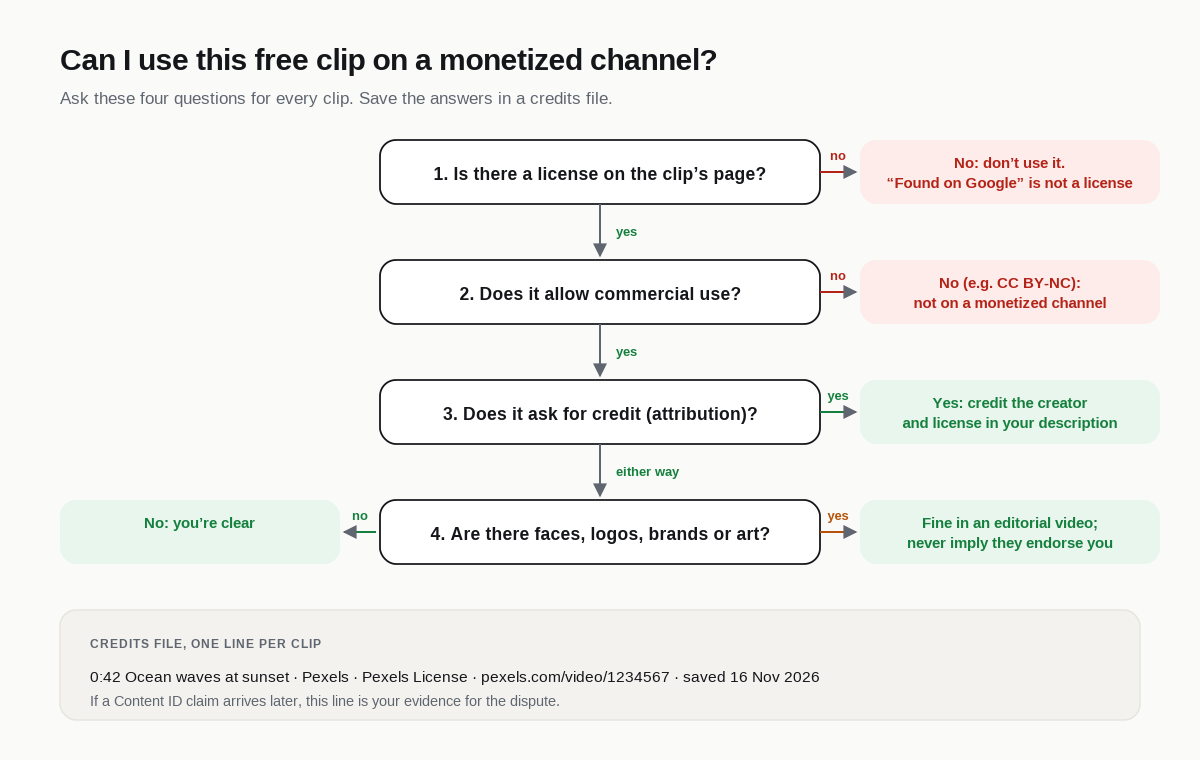
The Creative Commons part is simple once you know the letters (Creative Commons). BY means credit the creator, and SA means adaptations must use the same license. NC means non-commercial only, which rules out a monetized channel. ND means no changes, and cutting a clip into your video arguably is one. CC0 waives every right: use it any way you like.
1. Pexels: best all-round free stock footage
Pexels offers free 4K and HD video under the Pexels License: free to use and modify, including commercially, with no credit required. You can't sell unaltered copies, redistribute clips on other stock sites, show identifiable people in a bad light, or imply that people or brands in a clip endorse you. Its footage is strongest for modern life: cities, people working, nature, food. Pexels has a free API, but new API keys were paused when we checked.
2. Pixabay: biggest free library with a clear license
Pixabay has 240,000+ free stock videos, many in 4K, under the Pixabay Content License. No credit is required and commercial use is allowed. Two limits matter for YouTube: you can't redistribute clips "standalone" (unchanged, or with only a filter), which a narrated video isn't; and content showing recognizable trademarks, logos or brands can't be used commercially. Pixabay's terms were last updated 20 October 2026, and it has a video API.
3. Coverr: best for intros and backgrounds
Coverr's clips are free for commercial use with no credit and no sign-up. Its license, updated 4 November 2026, adds two rules worth knowing: you may not use Coverr clips to claim videos through YouTube Content ID, and you may not use them to train AI (Coverr License). Most clips are 4K. Some clips are AI-generated and flagged as such; if you use one that looks realistic, YouTube may require an AI label.
4. Mixkit: cinematic clips, but check which license
Mixkit (from Envato) has free 4K and HD clips with no credit required. Each clip carries one of two licenses. The Mixkit Stock Video Free License allows commercial projects, "for example in YouTube videos". The Restricted License is for personal social media posts only, so never use a Restricted clip on a monetized channel (Mixkit license).
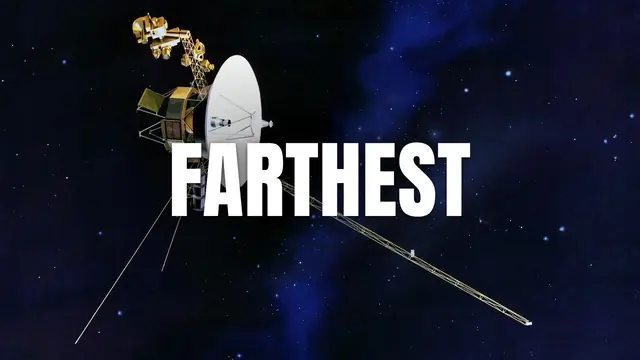
5. NASA: the best free source for space footage
NASA content is "generally not subject to copyright in the United States", so its images and video can be used in a monetized video (NASA media guidelines). NASA asks to be credited as the source. The rules: don't suggest NASA endorses you or a product, and don't use the NASA insignia ("meatball"), worm logotype or seal, which are protected. Current astronauts and employees can't appear in ads, and some material NASA hosts belongs to third parties. Search it at images.nasa.gov, which also has a free API.
6. Wikimedia Commons: history, people and places
Wikimedia Commons holds over 150 million media files, including historical film, maps and photographs. Each file has its own license: public domain, CC0, CC BY or CC BY-SA (Reusing Commons content). For CC BY and BY-SA, credit the author (not the uploader), name the license and link it; put it in your description. For BY-SA, whether your whole video counts as an adaptation is debated, so credit clearly. Commons also warns that photos of people may need the subject's consent for commercial use, and it doesn't guarantee any file's status: read the file page.
7–9. Prelinger, the National Archives and the Library of Congress
- Prelinger Archives (on the Internet Archive): about 6,000 films of 20th-century America: ads, industrial and educational films, city life. Its curators put it plainly: "Many people believe that all Prelinger Archives films are in the public domain. Some are. Many are not." Use films marked with the Creative Commons Public Domain Mark; credit isn't required (Prelinger rights). Public-domain films can still contain copyrighted music, so mute and re-score.
- Elsewhere on the Internet Archive, rights come from whoever uploaded the item, and many items are non-commercial only. The Archive "does not make guarantees as to the copyright status of items" (Internet Archive).
- US National Archives (NARA): works made by federal agencies are generally public domain, and NARA's own works are offered under CC0 for worldwide reuse. Donated material may be restricted (NARA). Superb for wars, presidents and US history.
- Library of Congress: it "generally do[es] not own the rights" to its collections, so check each item's Rights & Access section (Library of Congress).

10–12. ESA, Vecteezy and Freepik: read the fine print
- ESA (European Space Agency): standard ESA material is free for educational and editorial use but needs a licence for commercial use. Many Space in Images items are instead under CC BY-SA 3.0 IGO, which allows commercial use with a credit such as "ESA/Rosetta/NavCam – CC BY-SA IGO 3.0". On a monetized channel, use only the CC-licensed items (ESA terms).
- Vecteezy's Free License requires attribution and caps video productions at a $1,000 budget; 4K clips are Pro-only (Vecteezy licensing).
- Freepik / Magnific (where Videvo now points): free downloads require attribution to the site and the contributor; paid subscribers are exempt. Editorial-only items can't be used commercially (Magnific terms).
Why free clips get Content ID claims, and how to dispute them
Every upload is scanned by Content ID. Only owners of exclusive rights may use it, and YouTube lists "video that was licensed, but without exclusivity" as material that doesn't qualify (YouTube Help). Free stock is licensed to everyone, so a claim based on it is usually a mistake: someone registered a video that contains the same clip. Coverr's 2026 license now forbids exactly that.
To dispute a claim (YouTube Help):
- In YouTube Studio, open Content, filter by Claims, and click See details under Restrictions.
- Find the claimed segment under Content used, choose Take action, then Dispute.
- Choose that you have a license, and paste the clip's page URL and license from your credits file. Giving credit, owning a copy or not monetizing are not valid reasons.
- The claimant has 30 days to release the claim, reinstate it or let it expire. If they reinstate, you can appeal, and they then have 7 days.
Dispute only when you're sure: if the claimant files a valid takedown, the video comes down and your channel gets a copyright strike.
Can you monetize a channel built on stock footage?
Yes, if the stock footage illustrates something original. YouTube's reused content policy refuses channels that repurpose material "without meaningful original value", and a license doesn't exempt you (YouTube Help). A video made only of stock clips and music, with no narration or story, is at risk. The same clips under your own researched script and voiceover are a documentary, which is fine. More in can you monetize AI documentaries on YouTube? and how to get monetized on YouTube.
Keep a credits file for every video
For each clip, save one line: where it appears in your video, what it shows, the site, the license, the clip's page URL and the date you downloaded it. Paste the credits that need attribution into your description. If a claim arrives a year later, that line is your evidence. Our copyright-safe documentary footage guide goes deeper on archive sources and music.
VidGenn does this automatically. For every sentence of your script it searches public-domain and freely licensed libraries: NASA, Wikimedia Commons, the Internet Archive, Pexels and Pixabay, plus Openverse for images. It checks each item's license and gives you a credits file listing every source with your finished video. Plans start at $19 a month for 30 minutes of finished video.
Make a video with licensed footage
Common questions
Where can I get free stock footage for YouTube?
Pexels, Pixabay, Coverr and Mixkit (Free License clips) for modern footage, with no credit required; NASA for space; Wikimedia Commons, the Prelinger Archives and the US National Archives for history. All allow monetized videos, within each item's license.
Is Pexels footage copyright free?
It's free to use, not copyright free: clips are copyrighted and licensed under the Pexels License, which allows commercial use, editing and YouTube monetization without credit. You can't resell unaltered clips or imply people or brands in them endorse you.
Do I need to credit free stock footage on YouTube?
Pexels, Pixabay, Coverr and Mixkit don't require credit. Wikimedia Commons (CC BY, BY-SA), Vecteezy, Freepik/Magnific and ESA's CC items do. NASA asks for it. Crediting everything in your description is good practice either way.
Can I get a copyright strike for using free stock footage?
A Content ID claim is more likely than a strike, usually when someone wrongly registered a video containing the same clip. Dispute it with the clip's license from your credits file. A strike comes from a formal takedown request, which a valid license defends against.
What happened to Videvo and Mazwai?
Both now redirect to Freepik, which renamed itself Magnific in April 2026. Free downloads there follow the Magnific terms and require attribution.